Among our days in the Old City of Jerusalem, we spent time visiting holy sites of the Christian faith including the places Jesus was taken during his trial and crucifixion. Most of these sites have churches built over and around them so it’s somewhat difficult to get the feel of what it was like 2,000 years ago. And for the actual location of the crucifixion and burial of Jesus, there are differences of opinion between the Protestants and the orthodox groups.

The Via Dolorosa, monks, shops and more outside the Church of Holy Sepulcher.
My feeling after walking around was that as much as I like history and seeing ancient sites and wonders of the world, it’s the Spirit of God that is what moves us. That Spirit can be felt just as powerfully in a walk through the woods or along the sands of the beach as it can sitting in church or standing in the “spot” where Jesus was said to have risen from the dead.
Via Dolorosa
 On a Palm Sunday in the spring some 2,000 years ago, Jesus entered Jerusalem through the Golden Gate (now blocked up) on a donkey to the cheers of the crowds. He spent the week praying, scolding, and preaching. On Thursday of that week, he dined with his friends one last time before heading over to the Garden of Gethsemane at the base of the Mt. of Olives. I imagine the hike they took to get there took a while and they had to go down and across the Kidron valley. I wrote before about the steepness of the Mt. of Olives, where He went up to pray to the Father that night. And then once taken by the soldiers, He had to walk back up the steep hill and through the Lion’s Gate—the beginning of the path up the Via Dolorosa.

The indentation in the wall where Jesus placed His hand.
Via Dolorosa means “Way of Grief” in Latin. There are stations along the path that mark events that happened while Jesus carried the cross on the way to Golgotha hill, the site of the crucifixion. We stopped at these stations, starting with the churches that now represent where He was tried and beaten. We continued the walk up hill and saw an indentation in a wall where He stopped and placed His hand to catch His balance. As we hiked up the steps I kept thinking that His tortuous walk was made worse by the fact He had to do it uphill in the heat.
More stations marked points where Jesus fell down, saw his mother Mary, and was helped by Simon, the man who just happened to be visiting town on this fateful day. The walk ended at what is now the Church of the Holy Sepulcher.
Church of the Holy Sepulcher

The lavish decorations above the altar of the rock of crucifixion.
In Jesus’ time the location of the crucifixion and burial was outside the city walls. Back around 300 AD, Emperor Constantine’s mother decided these sites were located in the place that is now the Church of the Holy Sepulcher which houses the crucifixion rock, the place where His body was prepared for burial and the tomb where He was buried. The church is run by six different orthodox churches, each having a space in the church. Some in-fighting led to some interesting rules that were put in effect by the Muslims who were in charge of the city in the mid-1800s. One of the rules was “status quo” meaning everything that was in place at that time was to be kept exactly where it is forever. An interesting result is a ladder outside a second floor window used to help the monks get food and supplies during a siege is now forever in place as part of the façade. Another interesting fact is that a Muslim family holds the keys to the church and every morning one of the family members who has been named custodian, opens the doors.
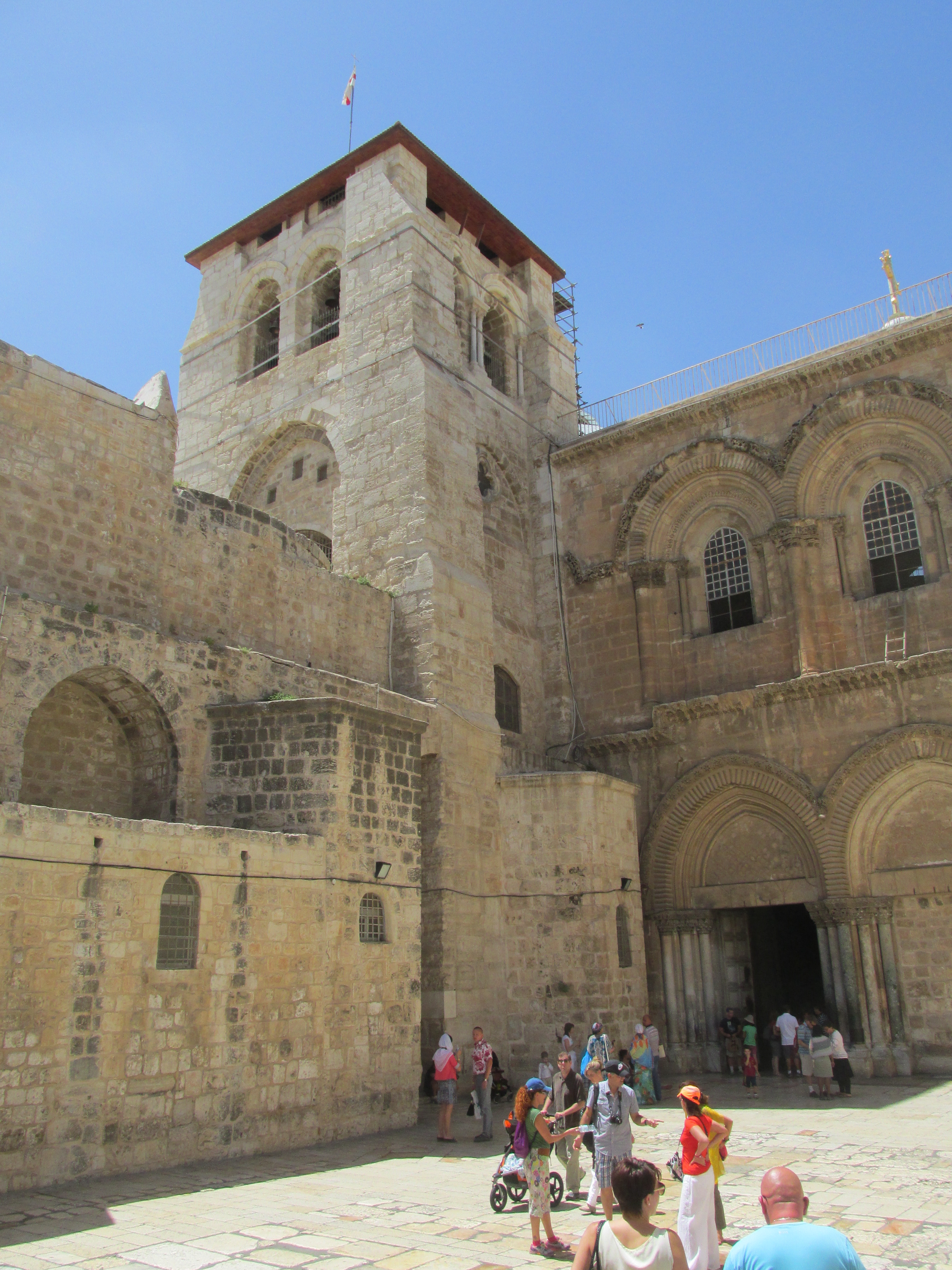
The Church of the Holy Sepulcher. You can see the ladder outside the top floor window to the right.
Upon entering, we walked up some steep stairs and lined up behind the masses to get the chance to touch the rock encased in a lavishly decorated room. There was an altar there and a hole where they believe the cross was raised. My mom and I bent down to get our feel of the rock before heading down to see some of the other altars located throughout the beautiful church.
We did not go into the structure that is said to house the tomb. It too was decorated with HUGE candles outside the door. Across from the tomb structure was a beautiful open area with a high dome ceiling. The paintings on the ceiling were of the four gospel writers and in the center of the floor was a religious stone called an omphalos, marking what was once considered to be the center of the earth.
My parents and I thought the church was quite beautiful; however it didn’t really give us a spiritual feeling. As Protestants we weren’t awe-inspired by the all the decorations and incense.
Garden Tomb

The Garden Tomb
Many Protestants believe Golgotha and the tomb are located outside the Damascus gate. We walked a little way down a road and reached a park-like setting called the Garden Tomb. It was absolutely lovely. It had a very tranquil feeling, natural in its beauty. From a bench we could view a large rock cliff. One of the reasons this is considered to be the location of the crucifixion is because the cliff appears to have a face on the side—thus the reason it was called the place of the skull. We continued along a path to the tomb, a cave-like opening in the wall of a cliff nearby. There is much evidence supporting the claim that this area is where the crucifixion and burial happened. What I know is that to me, it brought a feeling of peace and I could really imagine the events taking place here. (Here’s a video of the site with some information on the evidence.)

Golgotha near the Garden Tomb. A face can be seen in the rock of the skull.
It was a great way to end a very long day of touring. It was now the start of Shabbat so we went home to cook some dinner and prepare for our visit to Bethlehem in the morning.

The Garden Tomb has two places for bodies to be laid to rest.
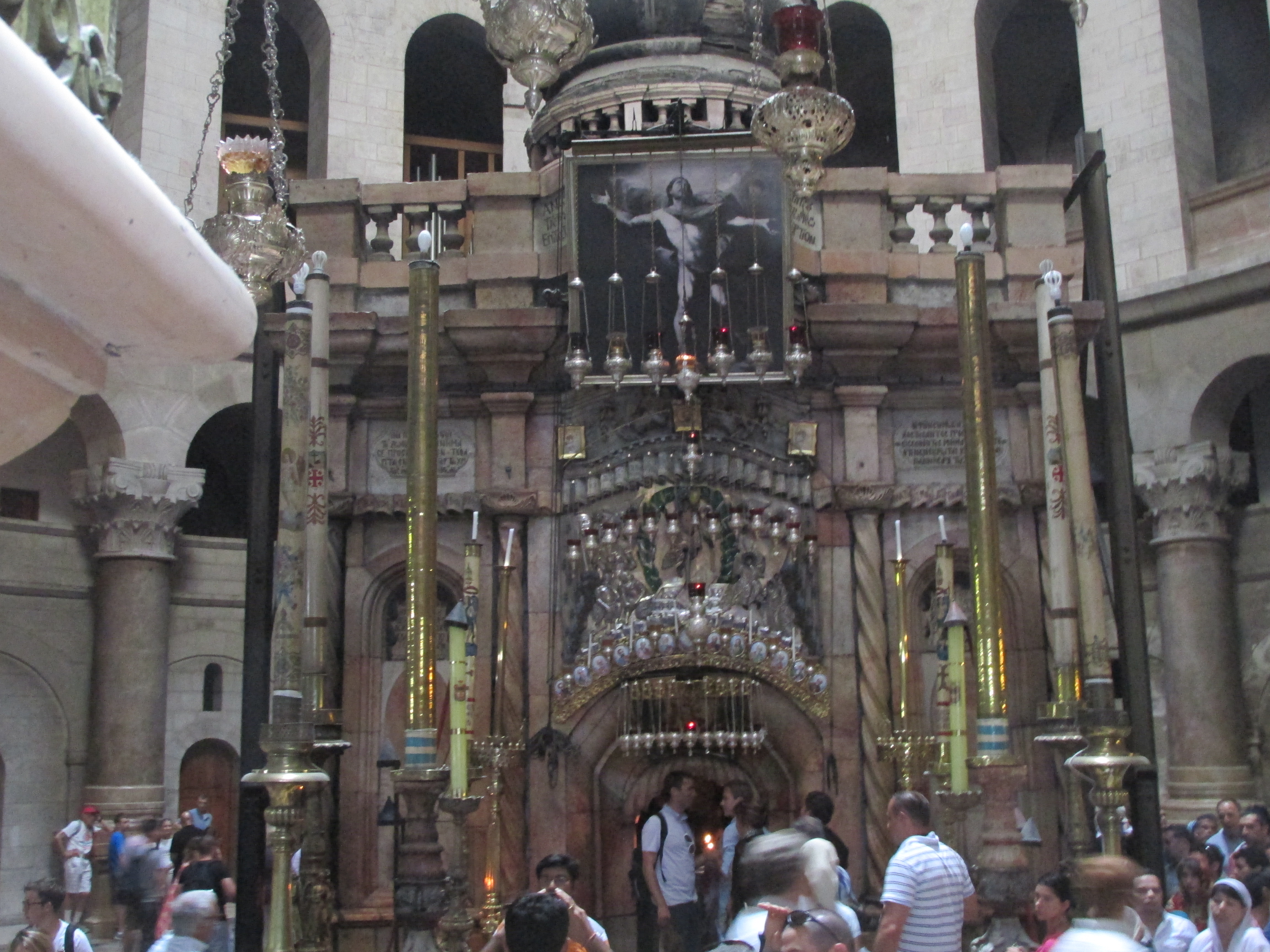
The Byzantine structure that surrounds the tomb located in the Church of the Holy Sepulcher.

The location where Jesus what convicted by Pilate.

One of the stations located along the Via Dolorosa.
Golgotha near the Garden Tomb. A face can be seen in the rock of the skull.
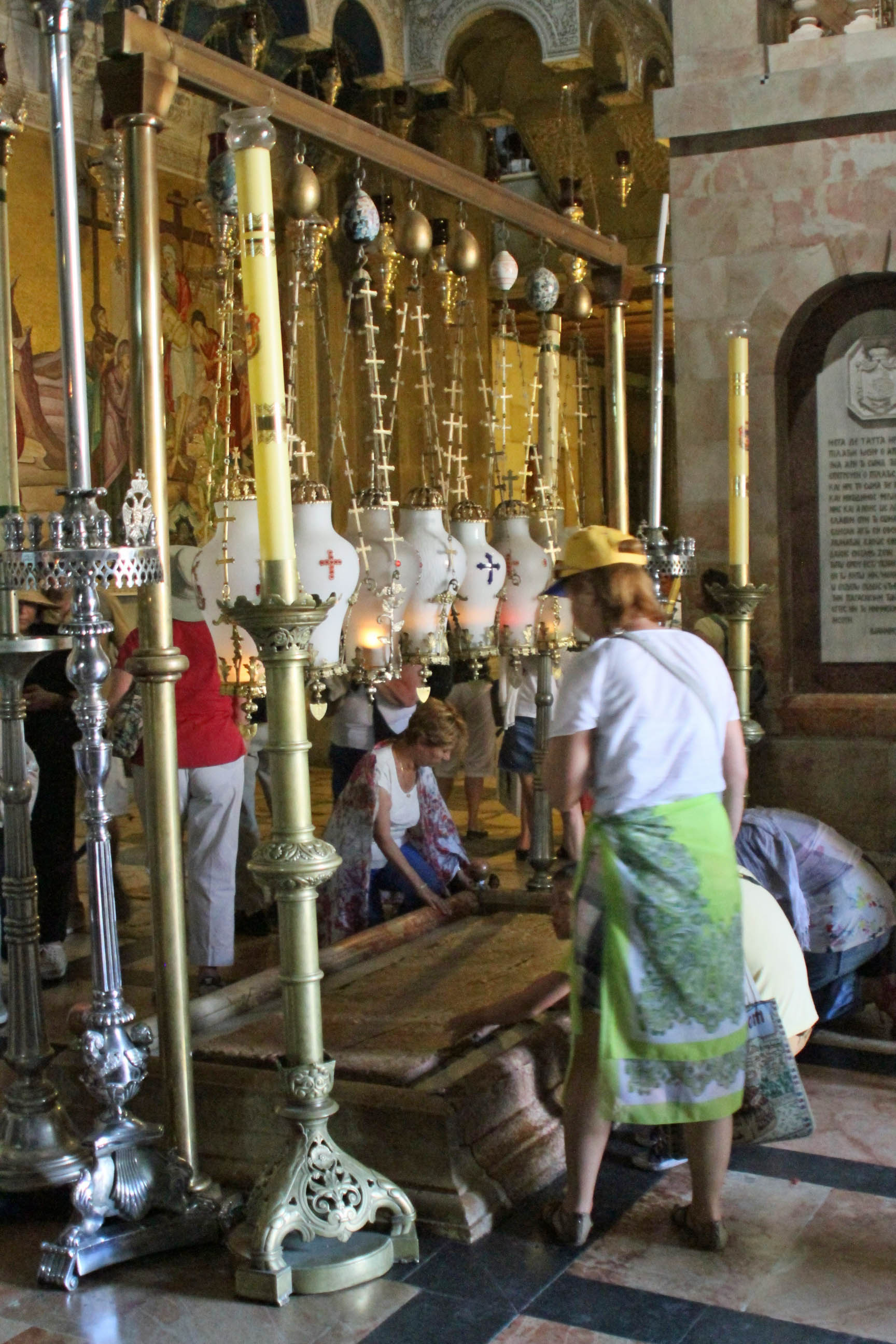
The place of Jesus’ anointing located next to rock of crucifixion in the Church of the Holy Sepulcher.

The Via Dolorosa.

A simple sign over an archway that opens into a small plaza outside the Church.
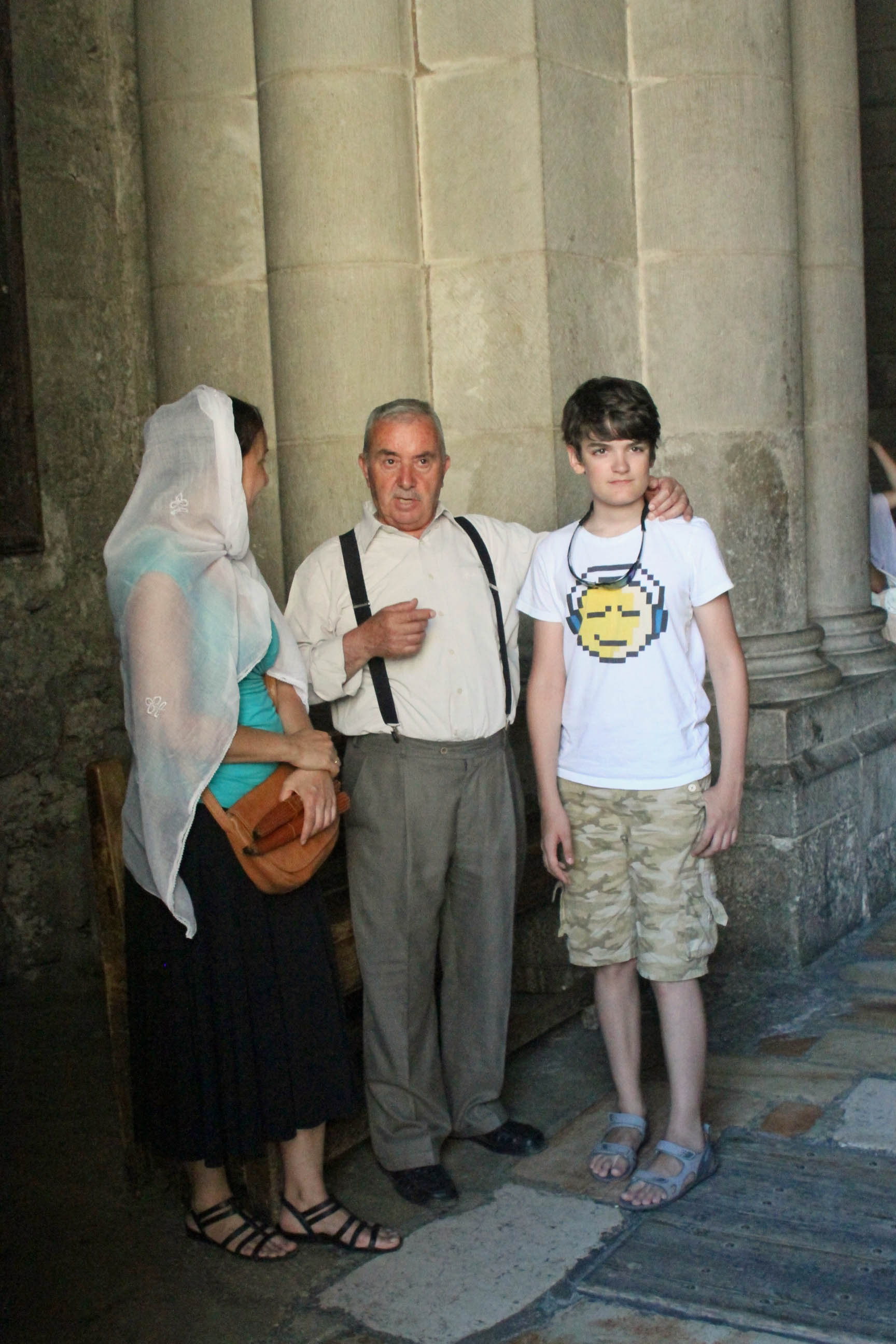
The keeper of the keys to the Church of the Holy Sepulcher.




 From the Observation Deck